
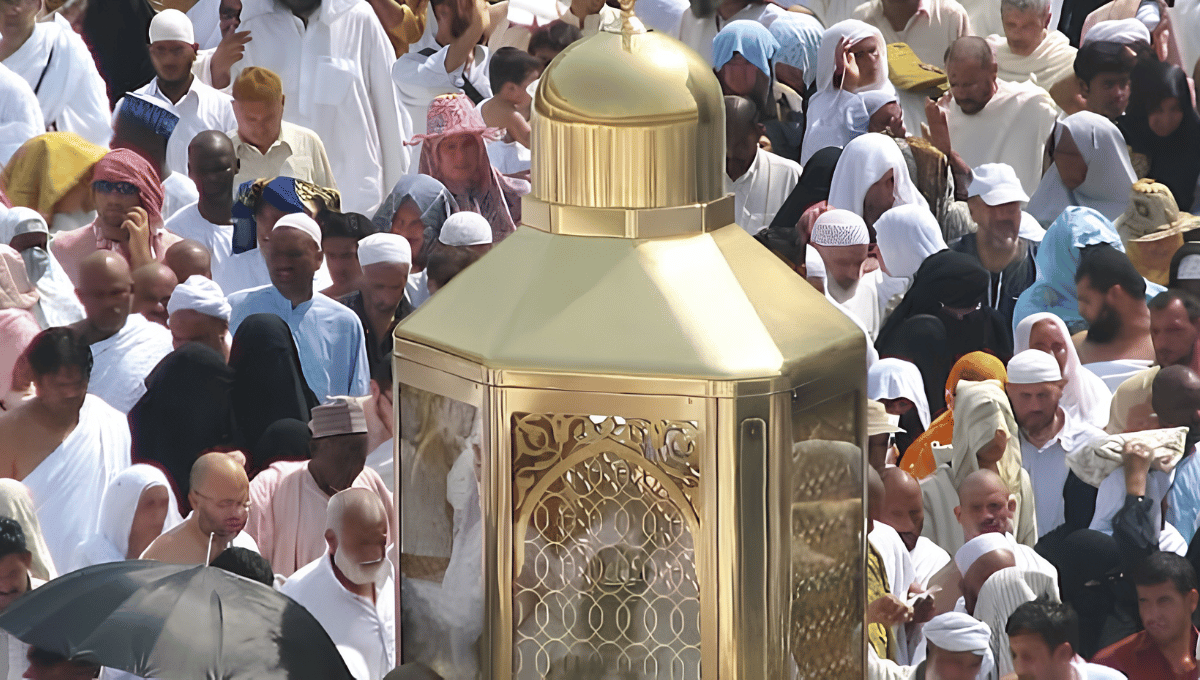
Walk to Masjid al-Haram, perform the seven rounds of Tawaf around the Kaaba and somewhere within that hallowed space in between crowds of pilgrims spilling out from every corner of this planet who come here for Allah, each act a prayer ascending into the clear sky—you will catch sight of a small gold-colored frame sealed in glass positioned just before the door of the kaaba.
That is Maqam e Ibrahim.
Most pilgrims who perform Tawaf know they must pray two rakats near it afterward, but few know its complete narrative: what it is, why it stands there, its Quranic foundation, and why Allah explicitly designated it as a place of prayer. In this article, we explore its history, Quranic significance, and practical guidelines for pilgrims.
What is the Meaning of Maqam e Ibrahim?
In Arabic, the word maqam means a place or point where a person stands. Ibrahim refers to Prophet Ibrahim (AS)-known in English as Abraham-one of Allah’s greatest messengers, whom Allah commanded to rebuild the Kaaba.
So Maqam e Ibrahim means, literally, the Station of Ibrahim, the place where Ibrahim (AS) stood.
Maqam e Ibrahim (Arabic: مقام ابراهيم, lit. ‘Station of Abraham’) is the stone on which Prophet Ibrahim stood when he built the Ka’bah in Makkah. Not a symbolic marker or plaque set in memorium. It is the Rock, it is the very rock upon which Ibrahim (AS) stood preserved for generations of people to see throughout history now encased in gold and glass within the Grand Mosque but still perched there for millions of pilgrims that pass by it to this day.
The Story Behind the Stone
To see the significance of this stone, you need to go back in time to the moment of Kaabah’s construction.
During this time, Allah ordered Ibrahim (AS) to reconstruct the holy House in Makkah. As the walls grew higher, his son Ismail (AS) passed stones to his father, while Prophet Ibrahim (AS) stood upon this stone, which miraculously elevated him to place the upper layers of masonry.
And this is the miracle Ismail (AS) would pass stones to his father Ibrahim (AS). Then Allah conferred on Ibrahim the footprints of him on that stone so a trace for a generation after that.
The stone served as a miraculous scaffold from Allah, rising and lowering at Prophet Ibrahim’s (AS) need. The footprints of Ibrahim (AS) were settled in the melted top layer of the stone. Not carved. Not engraved. Ibrahim strode onto the stone and it softened into a path, you can see where his holy feet left behind their impression even now.
The footprints can still be observed within the stone to this day thousands of years after Ibrahim (AS) erected the original Kaaba. Each pilgrim who prays at Maqam e Ibrahim is praying in the very place that one of Allah’s greatest prophets stood.
What the Quran Says About Maqam e Ibrahim
It is not a cultural tradition or something from the past.
And take the Maqam of Ibrahim as a place of salah. (Surah Al-Baqarah, 2:125)
There is actually a very interesting story behind this verse in tafseers. Reported that the Prophet ﷺ and Umar (RA) passed by the Maqam and that Umar said: Messenger of Allah, Shall we take this as a place of prayer? And it was indeed confirmed by the Prophet ﷺ Then Umar proposed to turn it into a place of prayer. He (ﷺ) replied that he was not ordered to do so. But that same day, before sunset the following verse was revealed “And take the Maqam Ibrahim as a place of salah.”
In the morning Umar (RA) himself had suggested it. So Allah revealed this verse in the night to eliminate any doubt. This is probably the most amazing case in Islamic history when the judgement of a companion has been affirmed directly through revelation, which says a lot about the importance of this stone. This site remains an essential part of Allah’s Sacred Sanctuary.
Here, above all sites in the sanctuary area: The Quranic verse quoted earlier does not relate to any other site within the sanctuary except for this stone.
Where Was Maqam e Ibrahim Originally?
This is a fact that surprises many pilgrims. Maqam was not here always.
During the time of Ibrahim, the Maqam was associated with the Kaaba. In the reign of the 2nd Caliph, Umar (RA) changed the old position of stone to make it easier for doing Tawaf and offering prayer. Everyone of the Sahabah agreed to this action as it was Umar who suggested that it must be used for prayer. Therefore, he shifted the place of rocks and transferred Maqam to the east. That is why today we find the Maqam e Ibrahim located in front of the doorway to the Kaaba.
This move was practical as having the stone to initially be against the wall of the Kaaba, and carrying out Tawaf properly while maintaining that piece in place was challenging. By shifting the east, there was more space available; the rituals of Tawaf as well as two rakat prayers were made easier for larger crowds of pilgrims.
How the Stone Has Been Preserved Across Centuries
Preservation of Maqam e Ibrahim has never been an easy task but it is remarkable how the pillars have always stood firm throughout Islamic history.
This stone has been maintained by Muslim rulers for centuries, with both the Abbasid and Ottoman dynasties fortifying its structure. Now, the stone is almost entirely encased in an enclosure of gold and glass that allows pilgrims to view the maqam of Ibrahim without touching it.
Maqam e Ibrahim, which is encased in a gold and glass enclosure with the stone on which the Prophet’s footprint has remained just next to the door of Holy Kaaba. The stone and footprints of Ibrahim (AS) are all visible to every pilgrim passing by through the glass. You do not require to have it up close in order to see it. As you spin around the Kaaba during Tawaf, it is obscured at different corners of your eyes by waves of worshipers performing Tawaf, but beams of light glint off its gold dome, always a part of the cacophony.
What Pilgrims Do at Maqam e Ibrahim
When pilgrims perform Umrah or Hajj the action at Maqam e Ibrahim is performed and has both its basis in Quran and Sunnah of Prophet ﷺ.
Upon finishing the seven rounds of Tawaf each pilgrim must perform two rakats next to Maqam e Ibrahim (place associated with Prophet Ibrahim). Narrated Jabir (RA) : After the Tawaf, he ﷺ performed Salah at the Maqam and recited “And take the place of Ibrahim as a place of prayer” (Quran 2:125), and offered two rakats with the Maqam positioned between himself and the Kaaba.
It is Sunnah to be at such a position where Maqam e Ibrahim remains in between yourself and the kaaba while offering prayer. In practice, however, due to the large number of pilgrims in the haram at all times, many people pray slightly back and in the same direction which is permissible. The direction and the intention are what is important.
Standing in prayer just a few feet in front of you are the physical footprints of Ibrahim (AS), glass covering his imprint, while the Kaaba stands directly behind the Maqam and it is both an obligation and one of the most breathtaking moments in all of Hajj.
Other Roles of Ibrahim (AS) at This Stone
The most prevalent reported link between Maqam e Ibrahim and rituals of pilgrimage are the two rakats after Tawaf, but that is not the only one.
When Prophet Ibrahim (AS) used to call the people towards Islam, it is also said that he stood on stone for this purpose, which we refer to as Maqam e Ibrahim. It is also mentioned that Prophet Ibrahim (AS) stood on Maqam e Ibrahim and called people for pilgrimage to Mecca.
This stone served as a scaffold during the Kaaba’s construction and later as a footing when Prophet Ibrahim (AS) proclaimed Hajj to mankind. When Allah commanded him, And proclaim to the people the Hajj [pilgrimage]… (Surah Al-Hajj, 22:27), Ibrahim (AS) asked how his voice would reach all of humanity. Allah replied, You make the call, and it is upon Us to convey it. Prophet Ibrahim (AS) then stood atop the Maqam and proclaimed: O people! Indeed, your Lord has built a House, so perform pilgrimage to it.
Thousands commit to this journey every year in answer to that eternal call, including hundreds of thousands of British Muslims.
A Pilgrim’s Guide to Maqam e Ibrahim
When preparing for Umrah as UK pilgrims, these are a few practical points to know in advance about the Maqam e Ibrahim.
Two Rakat prayers following tawaf are Wajib obligatory and must not be avoided. Note that a prayer done a little further behind and in the same direction is fine, if the area immediately ahead of the Maqam was packed. You don’t have to be up right in front of the gold cage.
Another thing worth mentioning is that sometimes people display their love and admiration by kissing or touching the Maqam. Scholars emphasize that pilgrims should avoid touching or kissing the glass enclosure, as this is not part of the Sunnah and causes unnecessary overcrowding.
To pray near Maqam e Ibrahim with a reasonable amount of space, the best time is close to Dhuhr and Asr prayer times or in the early morning when it is less busy. The Haram fills extremely quickly after every single adhan in peak times, such as during Ramadan.
Why Maqam e Ibrahim Stays With Pilgrims Long After They Leave
The praying in the two rakats near Maqam e Ibrahim have a certain quality that every pilgrim describes and that has nothing to do with the majesty of the building or whether it be made of glass, gold around a stone.
This is the burden of continuity. The comprehension that Ibrahim (AS) stood upon this very stone. That the Prophet صلى الله عليه وسلم prayed here after Tawaf. Umar (RA) pointed this locality to be a place of prayer and before the sun sets, Qur’an validated his opinion. That millions of Muslims over the last fourteen centuries have stood in this very place, made the same prayer and returned home differently than they had arrived.
When you are standing there, you are not standing alone. You are in a queue that reaches back to the origins of this faith joined, for an instant, to all of it.
Frequently Asked Questions
What is Maqam e Ibrahim in Masjid al Haraam?
Maqam e Ibrahim is positioned within the Mataf, the circled place used for Tawaf directly in entrance of the principal door of the Kaaba. Initially it was fixed to the wall of the kaaba, but during the caliphate of Umar (RA) it was displaced a few meters eastward in order for pilgrims to perform Tawaf easily.
What does the Quran say about Maqam e Ibrahim?
Allah explicitly mentions Maqam e Ibrahim in Surah Al-Baqarah (2:125), commanding believers: And take the maqam of Ibrahim as a prayer place. This verse was revealed on the same day further details of how to worship the stone (with respect) were proposed by Umar (RA). Only this site in the whole sanctuary is identified by this Quranic instruction.
What prayer do pilgrims offer at Maqam e Ibrahim?
After performing the seven circuits of Tawaf, every pilgrim has to offer two rakats near Maqam e Ibrahim as a Sunnah of Prophet ﷺ. The prayer is performed behind Maqam e Ibrahim if the standing place for worshippers is up next to Kaaba. Even if the site is crowded, praying further back in the same direction is fine.
Is it obligatory to pray at Maqam e Ibrahim during Umrah?
Yes. Offering a two-rakat prayer after Tawaf is obligatory (Wajib in Hanafi jurisprudence, and an emphasized Sunnah in other schools) on every pilgrim performing Umrah or Hajj. Do not skip it, but the position may vary if the spot is very busy.
Why are Ibrahim's footprints preserved on the stone?
When Prophet Ibrahim (AS) stood on the stone to build the Kaaba, Allah miraculously softened its top layer to preserve his footprints. In the stone, Allah preserved his foot prints as a sign and symbol for future generations, a remembrance of resilience by Ibrahim (AS) and heavenly assistance during its establishment.
Who displaced Maqam e Ibrahim from its original place?
The second Caliph, Umar ibn al-Khattab (RA), moved the Maqam from its original position right up against the wall of the Kaaba to its present site further east. The move facilitated pilgrims to perform Tawaf without being impeded, and it was agreed upon by the companions of the Prophet ﷺ.
Can you see the footprints of Ibrahim (AS) today?
Yes, the stone is encased in a gold and glass enclosure, enabling pilgrims (Mu’tamireen) to clearly see the impressions of Prophet Ibrahim’s (AS) feet after completing Tawaf.
What is the best time to pray near Maqam e Ibrahim during Umrah?
More space in between the Maqam usually during the quieter hours like between Dhuhr and Asr, or in the dark middle of night close to Fajr. And during Ramadan peak Hajj periods, the area fills up extremely quickly after each adhan, so praying a little further back in same direction is practical and permissible.
Is Maqam e Ibrahim connected to the call to Hajj?
Yes. In addition to being used in the re-building of Ka aba, Islamic tradition says that Ibrahim (AS) also stood upon this same stone when Allah ordered it to call mankind for pilgrimage. The call was announced by Ibrahim (AS) from atop the Maqam and since then responded to through generations of pilgrims.