
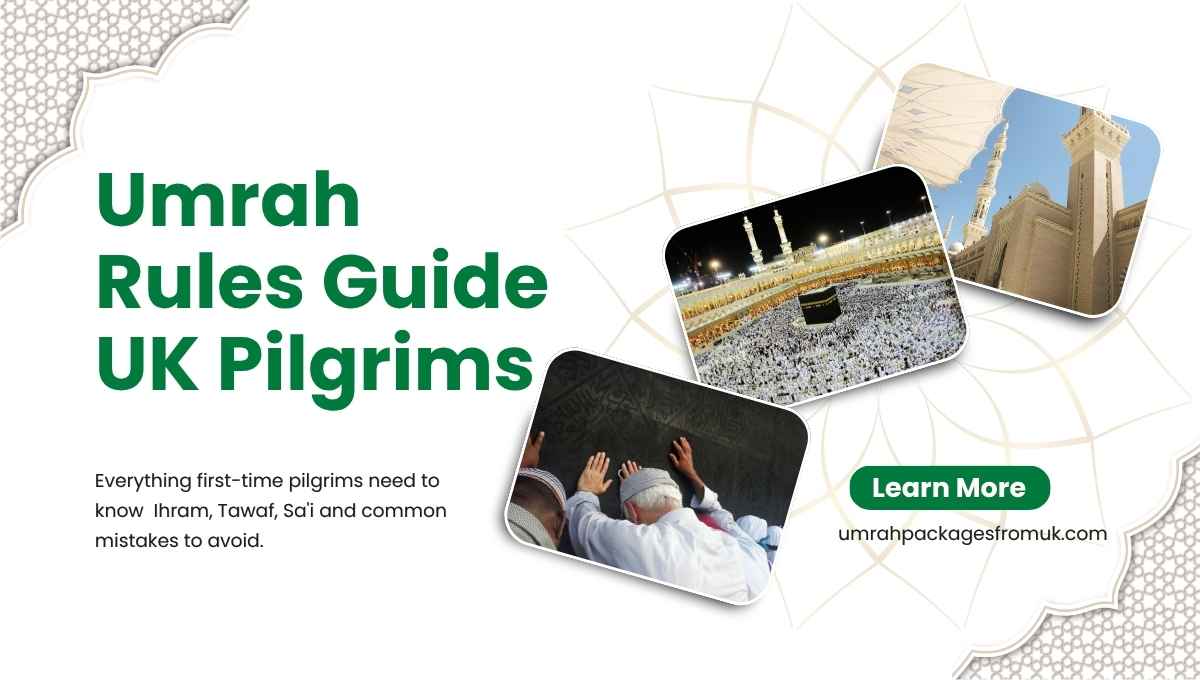
Umrah is much more than a holiday destination for the many thousands of Muslims travelling from Britain each year, it is a personal act of worship. From Heathrow to Manchester and Birmingham, one of the most common questions that UK pilgrims ask before their departure is straightforward: which duas should I actually memorise before going?
This guide compiles all fundamental umrah duas UK pilgrims ought to be aware of at each and every step from the time you walk out your front door until the last steps of Sa’i in between Safa and Marwah. All duas are presented in Arabic with transliteration (if necessary) and English translation so you can follow along even if you’re not a native Arabic speaker.
Why Duas Matter During Umrah
The performance of the Umrah depends on several rituals like Ihram, Tawaf and Sa’i; however, the dua which you recite in these rituals is equally significant as performing the action itself. The Prophet Muhammad ﷺ has instructed particular duas in almost all stages of the journey and having these duas known (and not reading blindly from a pamphlet without any understanding) makes this journey very fruitful indeed.
If you’re a first time pilgrim taking off from the United Kingdom, having these duas ready to go will take away a great deal of stress involved with learning how to cope with an unknown routine in the bustling Haram.
Dua Before Leaving Home (Travel Dua)
Before you even reach the airport, it’s Sunnah to recite a short travel dua when leaving your house.
Arabic: بِسْمِ اللَّهِ تَوَكَّلْتُ عَلَى اللَّهِ، وَلَا حَوْلَ وَلَا قُوَّةَ إِلَّا بِاللَّهِ
Transliteration: Bismillahi tawakkaltu ‘alallahi, wa la hawla wa la quwwata illa billah
Translation: “In the name of Allah, I place my trust in Allah, and there is no power or strength except with Allah.”
This is a good one to say quietly as you close your front door, and again as your flight leaves UK airspace.
Dua for the Journey (Traveller’s Dua)
Once you’re seated and the journey has begun, there’s a well-known dua for travel taken from the Sunnah.
Arabic: سُبْحَانَ الَّذِي سَخَّرَ لَنَا هَذَا وَمَا كُنَّا لَهُ مُقْرِنِينَ وَإِنَّا إِلَى رَبِّنَا لَمُنْقَلِبُونَ
Transliteration: Subhanal-ladhi sakhkhara lana hadha wa ma kunna lahu muqrinin, wa inna ila rabbina la munqalibun
Translation: “Glory be to Him who has provided this for us, though we could never have had it by our own efforts. Indeed, to our Lord we shall return.”
Dua for Entering Ihram
Once you reach the Miqat and put on your Ihram clothing, you make the intention (niyyah) for Umrah.
Arabic: اللَّهُمَّ إِنِّي أُرِيدُ الْعُمْرَةَ فَيَسِّرْهَا لِي وَتَقَبَّلْهَا مِنِّي
Transliteration: Allahumma inni uridul-‘umrata fa yassirha li wa taqabbalha minni
Translation: “O Allah, I intend to perform Umrah, so make it easy for me and accept it from me.”
The Talbiyah
Once in the state of Ihram, pilgrims repeat the Talbiyah frequently during the flight, in the taxi to the Haram, and right up until Tawaf begins.
Arabic: لَبَّيْكَ اللَّهُمَّ لَبَّيْكَ، لَبَّيْكَ لَا شَرِيكَ لَكَ لَبَّيْكَ، إِنَّ الْحَمْدَ وَالنِّعْمَةَ لَكَ وَالْمُلْكَ، لَا شَرِيكَ لَكَ
Transliteration: Labbayk Allahumma labbayk, labbayka la sharika laka labbayk, innal-hamda wan-ni’mata laka wal-mulk, la sharika lak
Translation: “Here I am, O Allah, here I am. Here I am, You have no partner, here I am. Verily all praise, grace and dominion are Yours. You have no partner.”
Many UK pilgrims find it useful to practise the Talbiyah out loud a few times before departure so it comes naturally once they’re in Ihram.
Dua for Entering Masjid al-Haram
Arabic: اللَّهُمَّ افْتَحْ لِي أَبْوَابَ رَحْمَتِكَ
Transliteration: Allahumma-ftah li abwaba rahmatik
Translation: “O Allah, open Your doors of mercy for me.”
Dua on Seeing the Kaaba
There’s no single fixed wording here the Prophet ﷺ would raise his hands and make personal dua on first sight of the Kaaba. Many pilgrims use this moment simply to ask sincerely for whatever is on their heart, alongside:
Arabic: اللَّهُمَّ زِدْ هَذَا الْبَيْتَ تَشْرِيفًا وَتَعْظِيمًا وَتَكْرِيمًا وَمَهَابَةً
Transliteration: Allahumma zid hadhal-bayta tashrifan wa ta’ziman wa takriman wa mahabah
Translation: “O Allah, increase this House in honour, esteem, respect, and reverence.”
Duas During Tawaf
There’s no obligatory fixed dua for every circuit of Tawaf, but between the Yemeni Corner and the Black Stone (roughly the last quarter of each circuit), it’s Sunnah to recite:
Arabic: رَبَّنَا آتِنَا فِي الدُّنْيَا حَسَنَةً وَفِي الْآخِرَةِ حَسَنَةً وَقِنَا عَذَابَ النَّارِ
Transliteration: Rabbana atina fid-dunya hasanatan wa fil-akhirati hasanatan wa qina ‘adhaban-nar
Translation: “Our Lord, give us good in this world and good in the Hereafter, and protect us from the punishment of the Fire.”
Outside of that, you’re free to make personal dua in your own words during the rest of Tawaf in English is perfectly fine.
Dua at Multazam
After Tawaf, if you get the chance to stand at Multazam (the wall between the Black Stone and the door of the Kaaba), this is considered a powerful place for personal dua there’s no fixed wording required.
Dua Behind Maqam Ibrahim
After completing Tawaf, pilgrims pray two rak’ahs near Maqam Ibrahim, reciting in the first rak’ah:
Arabic: وَاتَّخِذُوا مِنْ مَقَامِ إِبْرَاهِيمَ مُصَلًّى
Transliteration: Wattakhidhu mim-maqami Ibrahima musalla
Translation: “And take the standing place of Ibrahim as a place of prayer.”
Duas During Sa’i (Safa and Marwah)
Upon approaching Safa to begin Sa’i, it’s Sunnah to recite:
Arabic: إِنَّ الصَّفَا وَالْمَرْوَةَ مِنْ شَعَائِرِ اللَّهِ
Transliteration: Innas-safa wal-marwata min sha’a’irillah
Translation: “Indeed, Safa and Marwah are among the symbols of Allah.”
Standing atop Safa, facing the Kaaba, pilgrims then say three times:
Arabic: لَا إِلَهَ إِلَّا اللَّهُ وَحْدَهُ لَا شَرِيكَ لَهُ، لَهُ الْمُلْكُ وَلَهُ الْحَمْدُ، وَهُوَ عَلَى كُلِّ شَيْءٍ قَدِيرٌ
Transliteration: La ilaha illallahu wahdahu la sharika lah, lahul-mulku wa lahul-hamd, wa huwa ‘ala kulli shay’in qadir
Translation: “There is no god but Allah alone, He has no partner. His is the dominion and His is all praise, and He has power over all things.”
This is repeated between each of the seven laps of Sa’i, alongside personal dua of your choice.
Dua After Completing Umrah
Once the hair is cut or shaved (Halq or Taqsir) and Umrah is complete, it’s a good moment to thank Allah for the ease of the journey and ask for it to be accepted:
Arabic: اللَّهُمَّ تَقَبَّلْ مِنِّي إِنَّكَ أَنْتَ السَّمِيعُ الْعَلِيمُ
Transliteration: Allahumma taqabbal minni innaka antas-sami’ul-‘alim
Translation: “O Allah, accept this from me. Indeed, You are the All-Hearing, the All-Knowing.”
Practical Tips for UK Pilgrims
- Print or save your duas before you fly. Wi-Fi and mobile data in the Haram can be unreliable, especially during busy periods, so don’t rely solely on an app.
- Practise the Talbiyah out loud at home before your flight from the UK it’s repeated constantly once you’re in Ihram, and it helps to be comfortable with it beforehand.
- Keep a small dua card in your Ihram bag rather than a full book it’s easier to hold during Tawaf and Sa’i.
- Check your Umrah package departure city (London, Manchester, Birmingham) for flight timing, since Ihram is typically worn from before boarding if flying direct, or from the Miqat if you have a stopover.
- Don’t rush the duas. Many first-time UK pilgrims feel pressure to keep pace with a crowd it’s fine to recite at your own speed.
Final Thoughts
Knowing all these important duas for Umrah prior to making the trip can actually transform your entire experience, which would otherwise be nothing but going through the motions. No matter whether this is your first trip for Umrah from the UK or your second one, spending some time in advance and reciting the duas of Ihram, Tawaf, Sa’i and more, will definitely make you more involved.
For anyone who is already planning to visit Umrah in the coming months, here’s something interesting for you to know visit our Umrah packages from UK
Frequently Asked Questions
Do I have to recite duas in Arabic during Umrah?
Most of the specific Sunnah duas are recited in Arabic, but personal supplication (asking Allah for your own needs) can be made in English or any language you’re comfortable with.
What if I forget the exact wording of a dua?
The sincerity of the intention matters most. Reading from a booklet or phone is completely acceptable if you can’t recall a dua from memory.
Is there a dua for a safe journey back to the UK?
Yes the same traveller’s dua used for the outbound journey can be repeated for the return flight.